Have your New Year’s resolutions for English study or exercise already faded away? Every time we repeat the three-day rule of “작심삼일” (failing within three days), we comfort ourselves by saying, “I just have weak willpower,” or “That person can do it because they are a born genius.” I, too, vividly remember self-deprecatingly thinking, ‘Maybe my brain just isn’t built for this,’ after giving up on a coding course I had passionately started after work for just one week.
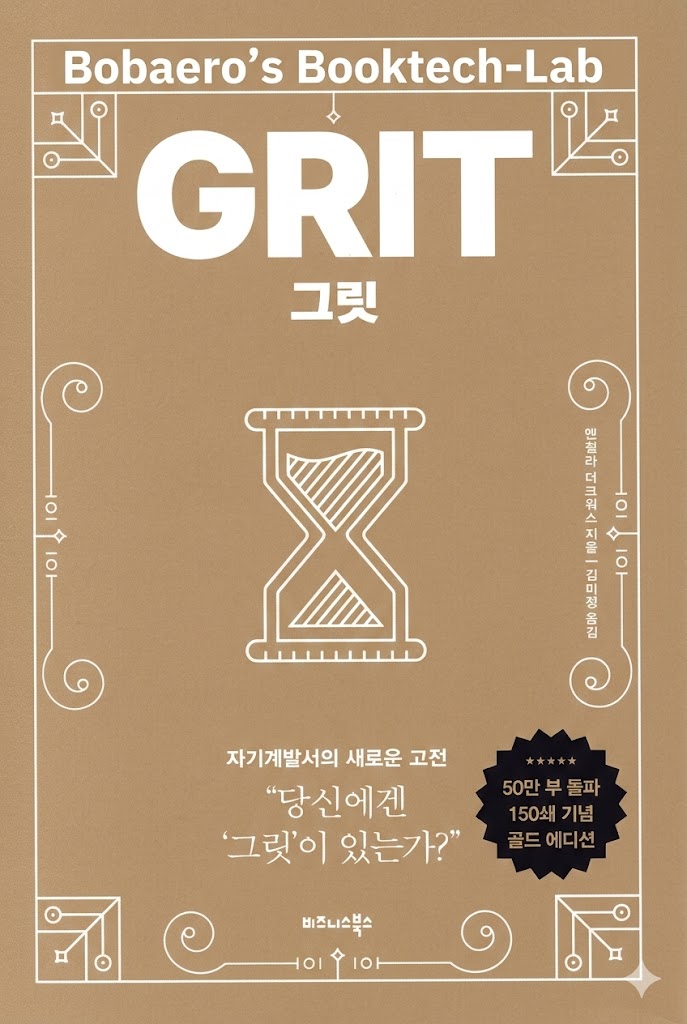
However, Angela Duckworth’s “GRIT” confronts us with a very cold yet fiery truth. It suggests that our failure is not due to low intelligence or a poor environment. It’s simply that we lacked the ‘Grit’ to push through until the end. Today, I’d like to share the psychology and reflections on ‘giving up halfway’ that we, as professionals, experience every day.
The Core: The Only Key to Escaping the Trap of Talent
The singular perspective this book piercingly delivers is that “Talent is 선천적 (innate), but skill and achievement are proportional to effort squared.” The author proves, through vast amounts of data and experiments, that the individual with GRIT—who possesses 회복 탄력성 (resilience) and dedicates themselves to a goal for a long time—ultimately wins over someone who is simply gifted with IQ or innate talent.
We often look at the achievements of a genius and dismiss them, saying ‘because they are special.’ That’s how we justify our own lack of effort. But Grit does not allow such cowardly excuses. ACHIEVEMENT is the formula: first, multiply TALENT by EFFORT to create SKILL, and then multiply that SKILL by EFFORT again. Ultimately, the person who does it until the end wins—an incredibly simple and powerful truth.
[Image showing Talent x Effort = Skill, Skill x Effort = Achievement formula]
Connecting to Life: Career and Relationships, “Consistency” is the Best Compound Interest
For a professional, Grit is more than just about workplace performance. We constantly deliberate over ‘choices’ to increase our salary or move to a better workplace. But in any field, the results do not show until you cross the 임계점 (critical threshold). Many colleagues look away just before that threshold, saying “I guess this path isn’t for me.”
Isn’t personal finance the same? The magic of 복리 (compound interest) can only be unleashed when the GRIT of ‘time’ is guaranteed. It’s the same for a career, investment, and even human relationships. There is an intangible asset that never accumulates for a person who easily gives up and switches. This book asks us: Are you multiplying your value with compound interest, or are you cashing out with단리 (simple interest) and starting over from scratch every time?
My Interpretation: Why I Initially Struggled with the Pain of “Deliberate Practice”
To be honest, when I first read this book, I thought ‘GRIT’ was just blind, brute-force root. So I felt a resistance, thinking, “Is unconditional 버티기 (hanging on) the answer? What about burnout?” I believed that running without a break could be poisonous, and that knowing when to flexibly give up was also wisdom.
But I realized how shallow my thinking was when I read about the core of GRIT: ‘의식적인 연습’ (Deliberate Practice). It wasn’t about blindly hanging on; the true face of Grit was about analyzing my weaknesses, correcting them, and집요하게 (persistently) digging deep. Until then, I had been indulging in the comfort of saying ‘I am working hard,’ avoiding the painful, truly difficult ‘real practice.’ That moment of reflection is what set me in motion again.
Action List: Things You Can Do to Build “GRIT” Right Now
- Forfeit One “Low-Level” Goal: Too many goals diffuse your Grit. Intentionally give up one minor hobby or ambition for the sake of your truly important high-level goal.
- The “Just 5 More Minutes” Rule: When you feel like finishing your work or exercise for the day, don’t check the clock; immerse yourself for exactly 5 more minutes and then wrap it up. Those 5 minutes will build your persistence muscle.
- Request One Specific Feedback: Ask a colleague or superior for one specific piece of feedback on the work you did today. Confronting your weakness is the beginning of GRIT.
Closing: Does Your Passion Have the Skeleton of “Persseverance”?
Everyone has passion. But few possess the Grit to push that passion until the end. Angela Duckworth tells us not to marvel at spectacular talent, but to pay homage to the성실함 (sincerity) of silently holding one’s ground.
Will you still love the work you are doing 10 years from now? When you fail, is it your head, or your heart, that will rise to meet it?