Are you still satisfied with just turning the pages of a book?
You’ve finished a whole book. You feel accomplished, but only for a moment. A week later, when someone asks you what the book was about, your mind goes blank. You’ve underlined passages and folded corners, but all that remains are a few fragmented sentences.
Why do we read but remain unchanged? Why is it that this knowledge never connects to a profitable outcome, but instead scatters and vanishes?
The Determinant Difference Between a Knowledge Consumer and a Knowledge Asset Manager
Many people mistake ‘reading a lot’ for competence. But massive reading is merely information overconsumption.
- Knowledge Consumers: Treat their brain as a conduit. Information simply enters and exits, leaving nothing behind.
- Knowledge Asset Managers: Treat their brain as a ‘Thought Editorial Room.’ They restructure what they’ve read in their own language, transforming it into an asset.
Reading without a recording system is like pouring water into a leaky pot. The intellectual satisfaction you feel is a ‘fake muscle’ that does not improve your practical judgment.
Reading is Not Knowledge Consumption; It’s the Assetization of Thought
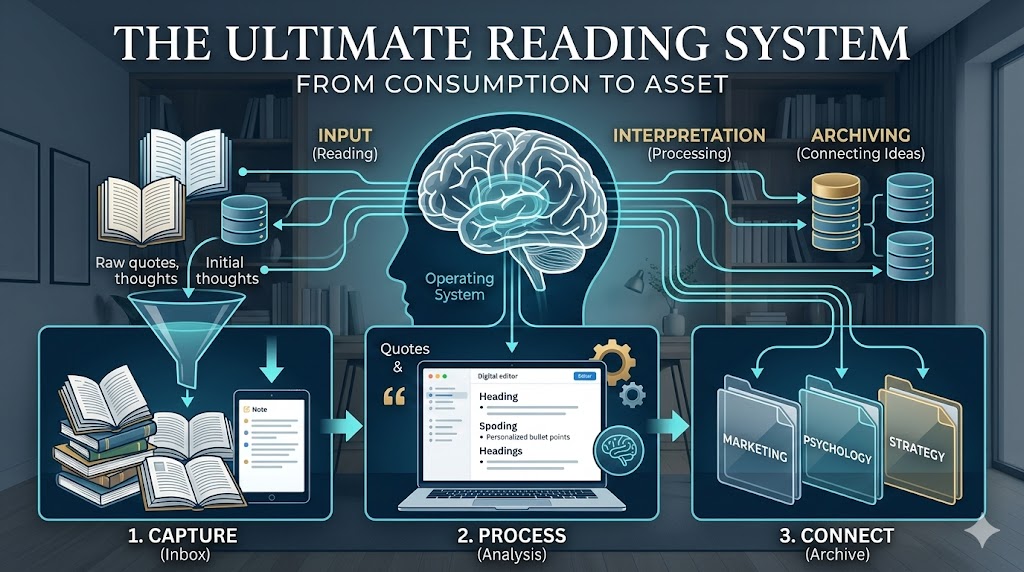
In terms of building ‘brain infrastructure’ that generates revenue, reading is the ‘process of transplanting another’s thought circuit into your own brain.’ It is not about saving information; it is about expanding the options for judgments you can make in specific situations.
Recording is the only means to solidify this transplantation process. Unrecorded knowledge is volatile, and volatile knowledge has absolutely no influence on your decisions. In the end, the reason reading doesn’t connect to profit is that you didn’t store it in a ‘reusable form.’
Thought Outsourcing: How to Record and Preserve
You don’t record for convenience. You record to ‘outsource your thoughts,’ allowing you to make better judgments later.
- Record Interpretation, Not Excerpts: Directly copying sentences is labor. Instead, answer the question: “Which problem in my business (or life) does this sentence solve?”
- Structured Storage: Do not organize by book. Restructure the knowledge topically (e.g., ‘Marketing,’ ‘Psychology,’ ‘Decision Making’) so that knowledge from different books can meet and ignite new insights.
- Searchable Index: Empty your brain’s memory. Delegate your traces of thought to digital tools (Notion, Obsidian, etc.) that are accessible at any time.
The Illusion that You Can’t Record Because of Time
If you skip recording to save time, you are actually wasting all the time you spent reading. Reading one book and recording three actionable drivers is infinitely more efficient than reading ten books and preserving nothing.
It doesn’t need to be complex. The simple structure that focuses on ‘Will I be able to reuse this information later?’ is more important than perfect organization.
Three-Line Summary
- Reading is not information acquisition; it is the process of building thought assets that improve the quality of your decisions.
- Reading without a recording system is merely a volatile hobby and will not connect to profit.
- Interpret in your own language, restructure topically, and outsource your thought to digital tools.
Up Next in the System: The ‘Knowledge Classification Method’ that Turns Reading into Revenue
Now that you know how to record, you must learn how to connect those records into a profitable model. Next, I will reveal the system blueprint that transforms fragmented notes into one gigantic ‘Knowledge Factory.’