Every financial book and YouTube creator eventually talks about the “Magic of Compounding.” At first, I dismissed it as a simple arithmetic problem—interest on top of interest. But after managing my own assets, I’ve realized that compounding is less about math and more about patience.
Why is it that two people with similar returns can end up with such a massive wealth gap over time? The conclusion I reached is that we fundamentally misunderstand how compounding grows. If your asset graph feels stagnant, it’s likely not a lack of skill—it’s that your compounding engine hasn’t warmed up yet.
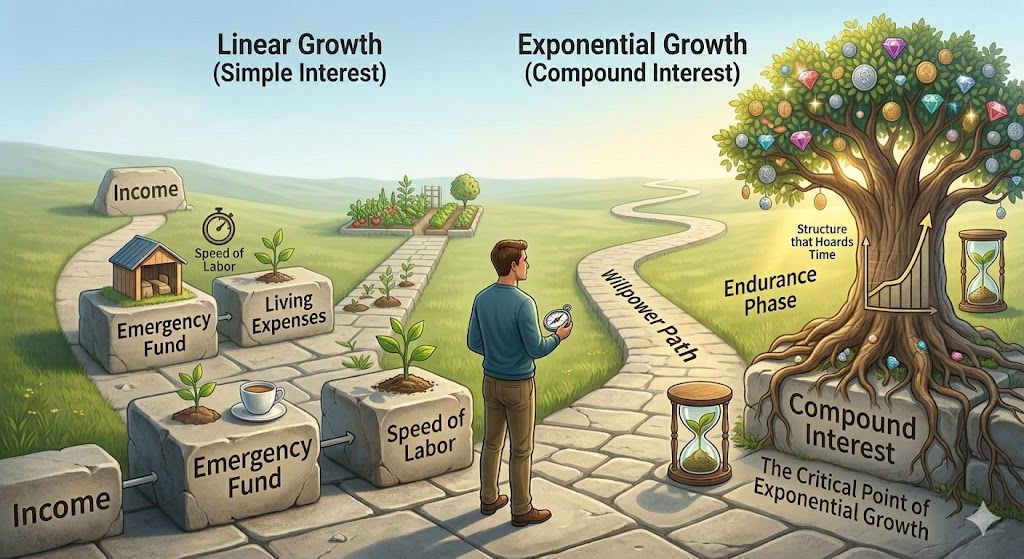
1. Simple Interest: The Honest, Linear Accumulation
A common misconception is that all savings or investments grow steadily in proportion to the principal. Simple interest only calculates gains based on the original amount. Because the same amount is added every period, it is predictable and stable.
I view simple interest as the “Speed of Labor.” It is an honest way to be rewarded for the work you do, but you cannot expect your assets to replicate themselves. Over time, the graph remains a gentle, straight line.
Bottom Line: Simple interest is a great way to preserve wealth, but it isn’t the engine that triggers an explosion of assets.
2. Compound Interest: The Critical Point of Exponential Growth
Compounding is a structure where the interest earned is added back to the principal, becoming the base for new interest. The biggest mistake people make here is expecting dramatic changes from the very beginning. The true face of compounding is hidden behind a very long, initial plateau.
I define compounding as a “Structure that Hoards Time.” In the early stages, the difference between simple and compound interest is so negligible that it’s tempting to quit out of boredom. However, once you pass the “Critical Point” where the curve steepens, you enter a stage where time, not just numbers, starts earning money for you.
Bottom Line: Compounding is perfected not by high returns, but by the persistence of never stopping.
A Shift in Perspective
The wealth gap isn’t determined by who is smarter; it’s determined by who stays in the game the longest. Our focus should not be on daily fluctuations, but on identifying where our assets sit along the compounding curve.
Psychological Freedom Through Structure
Once you truly understand compounding, the way you view spending changes. You stop seeing a $1,000 expense as just $1,000 today; you see it as the tens of thousands of dollars it would have become at the end of the compounding curve 20 years from now.
Anxiety disappears not when returns are high, but when you are certain that time is on your side. When you build the structure first and learn to wait, the noise of the market loses its power. Compounding is the reward reserved for those who conquer the human instinct of “impatience.”
Questions for Reflection
- In your investment plan, is “Time” a variable you try to control, or a constant you rely on?
- What is your personal “mechanism” for enduring the boring, flat phase of the compounding curve?